Grief 3 Ways

As you may have noticed, there is a running theme here lately, about grief.

I didn’t intend to write so much about it, but that’s the thing about writing – you don’t always choose your subjects. Sometimes, they choose you.

When my mom died, she was all I could think about, write about, but I kept it mostly private. This was almost nine years ago, when the blogging and online world was quite different. I wrote – as I’ve always done – to understand. It was more instinct than decision. Now, the journals I filled have become a reference for the work I’m doing now.

I’m almost done writing the content of my grief course which I’ll be facilitating on the site, The Gift of Writing, and it’s been quite a journey. Despite all the time that has passed, I’ve learned things about my mom and myself I didn’t know before. That is one of the hopes I have for the people who join my class. You don’t have to be a writer to sign up, you just have to be willing to write.

If you’re interested in receiving updates about the class, click here to add your name to the wait list and you’ll be notified when registration opens.

In the meantime…

grief 3 ways

I recently wrote a guest post on The Gift of Writing called, Every Grief Counts: How to Honor Your Grieving Experience. I feel strongly about the importance of this post because I think there can be a sense of competitiveness and comparison when it comes to grief.

Sometimes I have to remind myself that grief is extremely personal. But the questions still rise up. How long is it appropriate to grieve? Are some losses “worse” than others? Please take a look at the article if you haven’t seen it already, or pass it along to anyone you think may be interested.

I also wrote an essay about my mother and her caregiver, Lucie, and the different ways both women showed me their love. You can read that here, on the lovely site, Mothers Always Write.

Last, but not remotely least, I am so proud of my friend Anastasia for the second book in her Ordinary Terrible Things series, Death is Stupid, published by Feminist Press.

death is stupid

Using her gift of collage and her deep well of empathy, she has created a wholly original book about death – including all the nonsense (well meaning and otherwise) that people say to children when someone they love dies. I urge you to watch the book trailer, which will give you a glimpse at the magic she makes with words and art.

Just to assure you, despite all my grief-making work, I am not at all depressed. It’s spring, one of my favorite seasons, and I’ve seen enough daffodils and forsythia to prove it. Sure, the chilling temperatures are a bit of a downer (and I’m very sorry to my upstate and New England friends for SNOW, not cool), but sometimes I think we forget the capricious, fickle, and teasing nature of April.

It’s still early spring, nestled up against the cold cusp of winter, and maybe clinging to the old season a little more tightly than usual. I imagine a dozing bear, annoyed at being roused, and yearning for just a little more sleep before it lumbers out into the sunshine.

Here’s hoping it lumbers out sooner than later.


What’s in a Name

Last week, somehow, all my morning stars aligned.

While my son slept (in my bed) and my daughter snuggled in her bed (watching a show on my phone), I went downstairs and fixed myself a cup of coffee before settling down in front of the computer.

I was lucky, because minutes before my daughter hijacked my phone I saw the weekly prompt from The Inky Path and was immediately intrigued by the title: Your Name.

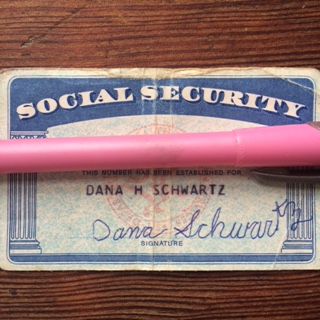
social security name

No one was asking me for breakfast – yet. I didn’t have to make lunches – yet. Birds floated gracefully around the feeder outside my office window while I wrote for ten blessed uninterrupted minutes.

Below is the inkling of the prompt (pun intended) and my response. I highly recommend heading over to The Inky Path and signing up for their FREE weekly newsletter and prompt. (They also have fabulous writing classes with reasonable fees. I’m not being compensated for saying such things, I just happen to believe them.)

Tell us about the name, or rather, your name. What is the story of your name? What is your relationship with the name that was given to you at birth? Do you use it as it is or in a shortened version? How has your name affected your life? Who would you have been with a different name? If you had the chance to choose your own name, what would it be?

I was never a big fan of my name. Dana Schwartz. It’s not as bad as my first (and last) Cabbage Patch Doll, Phyllis Hortensia (!), but it just didn’t mean anything. Well, that’s not true. Technically, Dana means from Denmark. But I’m not Danish.

I went through periods as a kid where I wanted to change my name. When I wished my parents had named me something else. Hailey was one of their choices. So was Robin. That was a close call. My father was concerned because he thought I looked a little like a bird when I was born. This was kind of true. He didn’t want anyone to make fun of me. My mom mentioned the name Summer once, and oh, I would’ve loved that. I was born in summer and I adore summer, so it would have fit.

How would my life be different if I were Summer Schwartz? It sounds kind of funny, but then most things do paired with Schwartz.

That’s another non-story. Schwartz was not my great grandfather’s last name. It was given to his family upon arrival at Ellis Island. Their name was Polanska. Too Polish? Too hard to pronounce? They gave them a new name, Schwartz, which means black in German, and that was that. An empty name. A placeholder.

A placeholder for what? A husband? I always considered, despite my feminist leanings, changing my name when I got married. But then I met a lovely man named Steven Plac. His last name is actually pronounced “Platz” in Poland, but here in America, they say, “Plack.” A name reminiscent of tooth decay. Sigh. What a waste.

Despite my husband’s wishes, I chose not to become Dana Plac. But it wasn’t just the sound of the name that made me hesitate, there was another reason I held onto Schwartz. It was my name. It belonged to me. Even though it had no bearing on my cultural background, even though I never liked how it sounded, garbled in the mouth, it was mine. I held it since I was born and giving it up felt like losing something.

Oh, but what about Summer? That sounds like a carefree girl. Someone who is not so uptight or worried or anxious. The kind of name of a girl who takes off her top at parties maybe, after too many drinks? The kind of hippie girl who dances around half naked around bonfires on the beach? Sorry, Summer, maybe you’re not like that. But there are worse things to be than carefree. Maybe it would’ve been nice not to be so damn self-conscious and concerned about what others think. Summer might not have cared. She might have danced right beside the fire and felt the warmth.

I don’t know who I would’ve been if my mom named me Summer. It comes down to mothers, somehow. I think my mother was the one to have the final say. It should be that way. We women do carry the babies. We know them before they emerge, we know about their secret selves.

As a child I held onto the idea that I could change my name. Maybe I could become Summer after all. I told my mother, when I’m 18, I’ll do it. But 18 came and went, oh boy, did it go, and here I am, forty years old, still holding onto my name, Dana. Two syllables, like Summer, but more solid, tethered to the ground, hearty, like a plant that digs in, takes root, and tilts its head toward the sun, feeling the warmth that way.

What do you think of your name? Did you ever consider changing it? I’d love to hear your story in comments.

Old Wounds

A few weeks ago, I dug out the stack of journals I wrote when my mom died. I filled almost 6 books from the end of June to the end of April. Ten months of grieving, nine months of carrying my baby. Two more journals written sporadically after the birth. New moms have limited time, as you can imagine.

journals

Opening old wounds is like peeling off a scab and watching the blood rise in tiny glossy beads. It stings, but also feels strangely satisfying.

Rereading these journals brings me right back to those early days. After only a few words, the tears that have seemingly dried up, or gone into hibernation, pour out. I welcome them, as painful as it is, because grief connects me to my mother.

It maintains and strengthens our tenuous connection, the invisible string that binds us together, from womb to body, from life to death.

I’m reading these old journals not simply for connection, but for research. As some of you know, I’m creating an online grief course for my friend Claire De Boer’s site, The Gift of Writing. The course, (tentatively) called Crossing the River, is about writing through grief. Not as a means to an end, but as a way to connect and integrate (healthy) grief into life.

This course isn’t just for those who are mourning a death. You can grieve the end of a relationship, whether it’s a break-up, divorce, estrangement, or abandonment. You can grieve infertility, the loss of a lifestyle, or a dream. In a podcast with Rob Bell, author and grief expert, David Kessler explains that grief is about change. Death is a big one, of course, but grief is how we deal and process any major change in our lives.

While writing this course, my grief has returned to me in fresh waves, but instead of rawness and confusion, it’s a release. The tears come and go and so do I. Moving forward in my life, grief is my shadow. Not a dark or scary one, but a companion that I find comfort in knowing is always there.

What are you grieving, right now?

I’ll keep you updated on the course, but if you have any questions or would like to be notified when it goes live, send me a note in comments or here: writingatthetable@gmail.com

The Art of Finishing: Guest Post

You have treasures hidden within you – extraordinary treasures… And bringing those treasures to light takes work and faith and focus and courage and hours of devotion, and the clock is ticking. – Elizabeth Gilbert, Big Magic

I’m so pleased to be up on The Gift of Writing with my latest guest post, The Art of Finishing: Manifest Your Writing Goals.

I’ve mentioned my struggle with my novel-in-progress more than a few times here on the blog, and it’s a challenge I suspect many can relate to whether or not you write. In my post I offer three simple ways to move past your own resistance, which can be defined as any thing, thought, or person that keeps you from achieving your goals.

Writing the essay helped clarify my own plan and I hope it helps others who find themselves stuck or sidetracked in any aspect of life, artistic or otherwise.

Please click here if you’re interested in reading the article. As always I’m honored by your support in whatever form it arrives!

P.S. If you haven’t already, consider signing up for my newsletter. You don’t want to miss my  upcoming Valentine’s Day inspired theme – Falling in Love with Podcasts: The Literary Edition!

When The Story Finds You

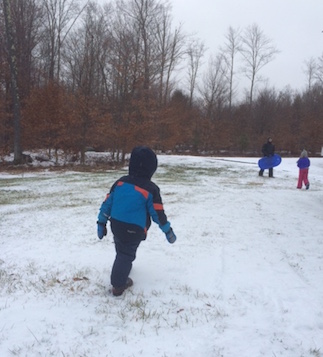
We spent our winter holiday in upstate New York on the edge of the Catskills. To our delight, despite initially mild temperatures, it snowed. Not much, but enough to coat the ground and frost the trees, enough for the smallest snowman and sledding.

snowy play 2At one point, I decided to take a walk. I grabbed a wooden walking stick and headed up the empty gravel road. Away from the shrieks of my children, there was little noise. Just the satisfying crunch of the stick as it punched holes in the snow and the sound of my breath.
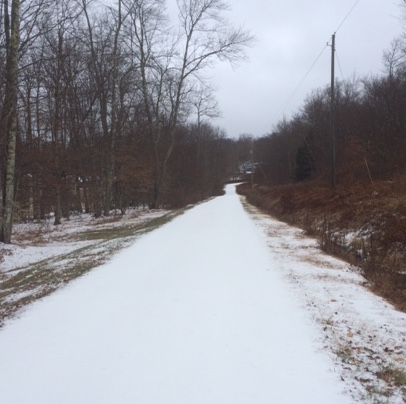
I’d forgotten how much I love walking, how fast thoughts rise up, like cream to the surface. After nearly a week indoors with my children – no snow to distract them, but thankfully, cable TV – I was finally alone.

snowy roadMy mind soon landed on a short story I’d been mulling over. A story about a family on the cusp of big change. A story that takes place in the Catskills. A story that happened to me. Since the specifics are hazy, and frankly too boring, I always knew it would be fictional.
With each step the story unwound like yarn in my mind, getting tangled up, unraveling, leading the way. I decided to write it in four sections, in the voice of each family member: mother, father, and their two daughters. I didn’t know yet the mother would be easiest to write, the older daughter the hardest.

I paused by a circle of pine trees and hesitated for a moment before heading into the brambles to explore. It wasn’t far off the road, there was no chance to get lost or hurt, but I hesitated. It’s how I’ve lived much of my life. Cautious, staying on the path, but lately, especially with writing, I’m taking more chances.

Back on the road, I stared at the smooth expanse of white snow. Without thinking, I began to write my mother’s name, as I used to do in sand at the beach, but instead of Mom, I wrote her name, Susan. Then I added these words: You Are Missed.

My mother, and the weight of her absence, is often just a whisper away.

Back in the warmth of the house, after hot chocolate and bedtime madness, I curled up in the chair between the rooms of my children and began my story.

It took me two weeks to complete, right in time for a mid-January contest deadline, which lit my initial fire. The story isn’t finished. I’ll tweak and sculpt more before sending it out to other contests, but the hardest work is done.

I don’t think I’ve ever written a story so quickly, but the truth is, it took longer than two weeks. I’ve had this story growing inside me for months, maybe years. The weekend I spent in the Catskills at age fifteen was the last vacation I ever took with my family. In fifteen more years, she’d be dead.

When you’re a writer, people love to tell you their stories. Oh, have I got a story for you, they say, perhaps expecting you to whip out a pen and take notes. It’s not their fault. Often their stories are fascinating, and could certainly make wonderful fiction or memoir. But in my experience, a writer doesn’t necessarily choose her stories – the stories choose her.

What themes do you return to over and over again? Is there a seed of a story growing inside you? Is it ready to bloom?

I’m so pleased to be part of Writing Bubble’s wonderful link-up. Come by, take a look, and perhaps join in!

What-Im-Writing-linky-badge


Edible Memories: Laughter

Sometimes I leap first.

When my online writing friend Stacey asked me to consider signing up for a 14-day writing group via the Inky Path, my first instinct was to say no. I barely have enough time to work on my novel, not to mention the grief course I’m creating, let alone the safety skills class I’m organizing – oh, and then there’s that whole mother/wife gig, plus my nemesis, the bottomless laundry basket.

But I couldn’t get it out of my mind. A tell-tale sign. As I kept tabs on the rising enrollment, I felt an itch, a twinge, but couldn’t tell if it was a competitive-fear-of-missing-out or the I-need-to-do-this kind of feeling. Looking back, it was probably a little of both.

One week into the Winter Joy Retreat: Edible Memories, and I’m fully immersed. It’s pretty impossible to keep up with the group’s Facebook posts (over 100 people registered, though not all post daily) but I’m trying to hold fast to my own commitment, one writing prompt each day. This isn’t easy – my kids are young and life is full, but I’m delighted to say that – so far at least – I’m making it happen. I’ve always felt like my memory is kind of bad, but each prompt seems to unlock one, two, more scenes in my mind, and I’m taking notes like mad, for both the prompts and the possibility of memoir.

I’d like to share with you my most recent prompt. The theme was Laughter (with an emphasis always on food) yet somehow I managed to turn it around to sadness (just like the character on Inside Out!). But that’s how I’ve always been. Drawn to the bittersweet, both in food and life.

Winter Joy Retreat: Edible Memories

Laughter

Thanksgiving has long been my favorite holiday. As a kid we took turns having it at our house, but after my mother’s MS diagnosis, we always hosted. My uncle, king of turkey and CEO of stuffing, would come to our house in the morning with bags of supplies, plus a bonus bag filled with appetizers from Zabar’s: salami, cheeses, crackers, olives, lox spread, and bagels.

He’d pop the prepared turkey in the oven and it would cook all day while we snacked and cracked jokes. When it came time to eat, my father would hoist my mother into her scooter and drive her into the dining room after she could no longer do so herself. We’d eat and laugh, and when all us kids were of legal age, or close enough, drink some wine.

My memories of Thanksgiving were almost always punctuated by laughter. Especially in the earlier years, before my mother’s pain became unbearable.

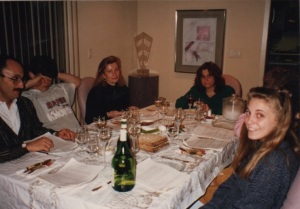
This was from Passover, but same crew, without the matzoh.

This was from Passover, but the same characters.

The house was always filled with warmth and smelled of roasting turkey and marshmallow topped yams. My uncle would always cook the main meal. My cousin Pia would always bring dessert. My mom always insisted on making, or instructing me how to make, her favorite side dish, green bean casserole. And I always had to have a slice (or two, three) of pumpkin pie topped with Cool Whip.

Maybe that’s what I loved most about Thanksgiving – the “always’s,” the traditions we had curated and nurtured over the years. We were Jewish and didn’t have the show stopper of Christmas to look forward to, so I banked all my love and hope on Thanksgiving.

Things weren’t always so rosy, of course. There were fights and tantrums, angry words and slammed doors, more so as the years edged on to darker times, but mostly I remember the laughter.

The time when my cousin Ari and I stumbled upon a very strange AOL chat room in the late 90s. Don’t ask me why or how this happened, but let’s just say we were beside ourselves with hilarity when we ended up in a conversation about fruit fetishes, among other things.

Then there was the time my grandmother got drunk. Alcohol was pretty minimal at our house, even on the holidays, but somehow she had gotten her glass refilled one time too many and ended up divulging a bizarre genetic glitch afflicting several relatives. I’m almost positive somebody spit out their mashed potatoes, or at least choked on their soda.

Laughter filled the rooms and rang through the kitchen and seeped into the walls, so that when it ended, I could feel its echo.

My mother’s last Thanksgiving was hard. There was little laughter. The mood was dour, tense. My husband and I thought it might be helpful to order dinner from Fresh Direct and bring it from Brooklyn, rather than have my uncle cook in the house since my mom was feeling worse. The king of turkey did not take kindly to what felt like a personal affront. He sulked in the kitchen eating his “take-out” meal while the rest of us sat in the family room with my mother, who was too uncomfortable to transfer from her reclining chair.

I remember feeling desperate for some levity, anything to lighten the mood, to coax my uncle out of the kitchen, to ease the tension with my brother, to make my mother laugh. But nothing worked. We sat on the couch for what felt like an uncomfortable amount of time, and I rolled my eyes at my cousin Pia when our brothers began talking of sports, not with any vigor or enthusiasm, but dully, as if they had nothing else to say. Perhaps because they didn’t.

When everyone finally left, I felt a heavy weight settle around my shoulders as I dumped the leftovers in the trash. Looking back, I wonder if my sadness was actually a sign, a warning. It left me uncomfortable. A sense of foreboding prickled up my spine.

I thought, next year will be better. Next year has to be better.

But it wasn’t, because my mother was dead.


What-Im-Writing-linky-badge

Thank you to Maddy over at Writing Bubble for hosting her What I’m Writing link-up. Check it out for more wonderful words.

Own Your Story

I never thought I’d consider writing a memoir.

Fiction is my genre. It always has been, ever since I was a little girl crafting “books” out of construction paper and crayons. When I declared myself a writer at some point in elementary school, I wanted to write stories. I wanted to make stuff up.

There’s a safety in fiction that doesn’t exist for memoir.

Maybe that’s why I kept myself firmly planted there for so long. I never had to be held accountable. I could always say, it’s just a story, if anyone bothered me about autobiographical details.

Of course every writer, no matter the genre, weaves in elements of themselves, their lives, in their work. If not things that happened to them directly, then things they observed, sensed, or felt. Creativity doesn’t happen in a vacuum. But fiction writers can hide behind a cloak of invisibility – or at least, pretend to do so – while memoirists are stark naked.

Over the last couple years, I’ve been taking some different kinds of chances. I wrote about witnessing my mother’s death and the birth of my first child, about postpartum depression and my daughter’s celiac diagnosis. Stories that belong to me, but also, in a way, to my family.

The part of me that values privacy – and secrets – wanted to muffle this new tendency. But something shifted inside me, a curiosity began to unfold.

Recently, a writer friend left a comment on my blog post that flung the door open wide open (thank you Julie Gardner).

“You have a memoir in there.”

Her words stopped me in my tracks. They sunk in and took root, even when I tried to brush them away.

They were part of what inspired my recent guest post on The Gift of Writing.

Own Your Story: Overcoming Fear About Writing Memoir is about my journey, which is still in progress, but also contains universal truths that I discovered in my research about common themes that hold people back from telling their stories.

Please take a look if you’re interested in the topic. Thank you as always for reading my words, here and beyond.


Life After Loss: Writing Through Grief

Alhough it’s been eight years, my mother’s death remains one of the biggest turning points of my life.

mom and me

Almost immediately afterward, everything became filtered through a new distorted lens. I felt like a book that had been torn in half. There was part 1, all that had occurred before my mom’s death, and part 2, what came after.

I remember feeling so raw and exposed that summer. My heart felt like it had been scooped out of my chest. I dragged myself through the days in a strange kind of stupor. Nothing looked or sounded quite right. People were too loud, too happy, too eager to offer advice about my grief.

One well meaning friend kept insisting I see a blockbuster comedy that opened that summer. It’s so hilarious, she said, it will make you laugh. But what she didn’t understand was I didn’t want to laugh. I wanted to hunker down inside my grief. I wanted to feel every stab of pain and every searing ache. Funny movies and even most fiction felt frivolous and unimportant. I turned to poetry when I couldn’t bear prose. I made scrapbooks and photo albums. I cried, a lot.

Grief was my work, and I stepped into it willingly. Not because I thought it was the right thing to do, but because it was the only thing I could do.

Recently, my friend Claire over at The Gift of Writing asked me to write a post about grief. I focused on how journaling connected me to my mother and helped serve as a conduit for my pain, both before and after her death.

Writing was the one thing I could do anytime, anywhere. It was where I could be completely honest about how I felt, with no one pitying or judging my process.

Please stop by if the topic resonates. I’d love to know what you think.

gift of writing


Sharing Our Stories

The final installment of my series, Unpacking Your Creative Life, is up on The Gift of Writing. It was my favorite one to write, focusing on the importance of connecting with other writers and sharing your work.

gift of writing

Writing is crucial to success, of course, but if we don’t have company along the way, we are more likely to walk away.

“It is deadly to be without a confidante, without a guide, without even a tiny cheering section.”

Women Who Run With the Wolves by Clarissa Pinkola Estés

I am so grateful for the community of writers I’ve met online, here and beyond, some who I’ve never met, but feel as dear to my heart as those I’ve known for decades.

Yes, it is vulnerable to put your work out there for others to read (and in this day and age, instantly respond), but that’s why having supportive friends is crucial. They will be there to lift you up when the world pushes you down. They will remind you of what’s important – your story, your truth – and to ignore the white noise of those who don’t understand or enjoy stirring up trouble.

In the spirit of sharing, and most certainly vulnerability, here I am at the 2015 Listen To Your Mother Lehigh Valley show.

Motherhood is Obliterating

Why didn’t anyone tell me this? Is it too much of a buzz kill to mention that possibility in childbirth class?

I’m pretty sure I would’ve benefited from a head’s up.

I was, utterly, unprepared for motherhood.

But that’s pretty much all of us, isn’t it? No matter how many classes we take on birthing a baby, or that useless one about infant care when they teach you how to diaper a doll, we’re all air dropped into a foreign country when it comes to new motherhood.

This November, an essay I wrote about my post partum experience will be published in an anthology aptly titled, Mothering Through the Darkness (She Writes Press, created by the HerStories Project). It’s now available for preorder.

MOTHERINGTHRUDARK (1)

For months I hesitated to write my story, let alone submit it, because I didn’t know if it “counted.” Sure, I had a hard time as a new mom, but I hadn’t been diagnosed with postpartum depression. I hadn’t sought help.

Looking back, it’s clear I needed it. I wonder if I had read some of the essays in this collection, if I would’ve reached out instead of holing up. I don’t know. But I do know that I’m proud to be part of an anthology that broadens the spectrum of postpartum distress.

When I was pregnant I used to watch this ridiculous baby show on TLC called, “Bringing Home Baby.” There was something comforting about watching the new parents return home psyched but frazzled. The cameras followed them as they basically lost their minds.

But they always ended the show the same way, about six or eight weeks later, with everyone looking and sounding like they had gotten their act together. Every now and then I’d catch a glimmer in the mother’s eyes, a primal flash of fear, but then they’d cut to the cute gurgling baby batting at a mobile in her crib or sleeping in a bassinet. All was well. Show over.

But life doesn’t work like a TLC show (thank goodness, really TLC, you have gone downhill). It doesn’t wrap up neatly as the credits roll and the parents take their sweetly reclining baby on a stroll around the block.

Mine certainly didn’t, and I suspect, most don’t.

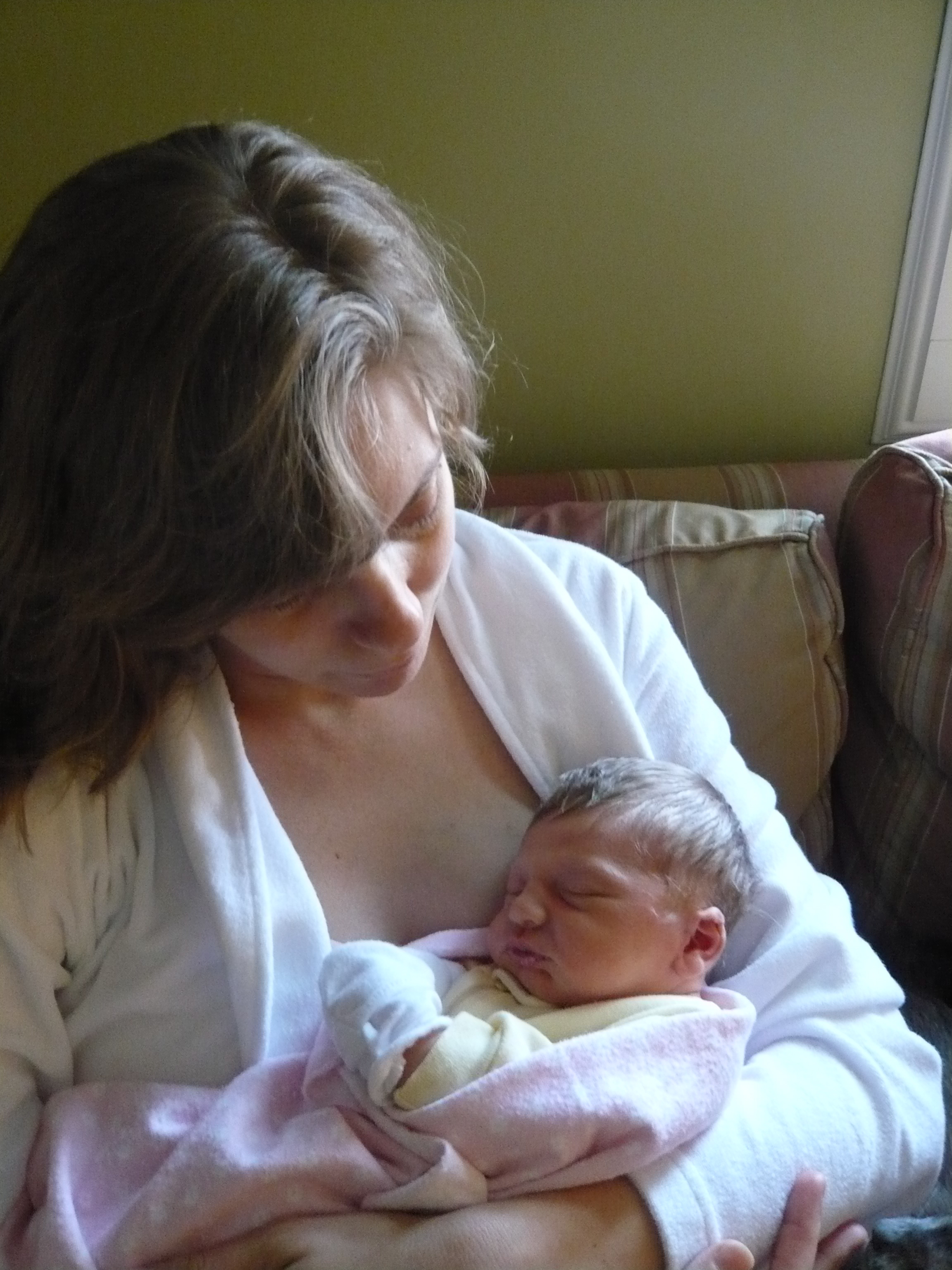
The early days with my baby girl.

The early days with my baby girl.

I still have no idea if I had postpartum depression or postpartum anxiety – an ailment I didn’t even know existed back then. But I do know that new motherhood kicked my ass. Hard.

Do you want to know what I wish I had known? (Hint: It has nothing to do with breastfeeding, vaccinating, sleep training, or any other hot topic parenting topics.)

How completely I would lose myself.

Not temporarily, but forever. The woman who left for the hospital with a baby contracting in her belly did not return that evening. A different person arrived in her place, holding a baby, with aching breasts and a sore battered body.

Perhaps if I had only known about the irretrievable loss of my old self and the necessity of forming a new one, maybe life after birth wouldn’t have felt so bewildering. Maybe.

Of course I’d heard the warnings, the catch all, “Nothing will be the same,” but people said that in relation to physical things, like my body and sleep.

The insinuations were that my life as a mother would be different than my life as a non-mother. I knew there was no going back to my single unattached self, but I assumed I’d slowly collect the pieces of my shattered identity as time went on.

I’d be able to write again, go out at night, visit with friends, and go on vacation with my husband. All this would be returned to me when the baby got older, learned to sleep (ha, try never), or went to school.

But what became apparent as time went on was that there was no milestone that would return me to my old self. I had to forge a new one.

This sentence in the August 2015 edition of Harper’s magazine article, “The Grand Shattering” by Sarah Manguso (author of Ongoingness, a book I just bought) sums it up:

“[Motherhood] is a shattering, a disintegration of the self, after which the original form is quite gone.”

Maybe other women realize this sooner, or maybe this isn’t a lesson everyone needs to learn. I imagine that some women find their way intuitively, or that the new self that motherhood creates is one they fall into like a warm embrace.

In an NPR interview, Jenny Offill, the author of the brilliant book, Dept. of Speculation eloquently states what I felt and continue to feel, which is that the conversation about motherhood is a little narrow.

She explains that when women speak about motherhood, the only other option besides pure bliss seems to be ambivalence. But for the women she knew who had become mothers, it was more complicated than that, “especially for women who had a great passion for some kind of work.”

“They were struggling to bridge the person they used to be with the person they were now, and that maternal love, which is quite fierce can be obliterating of what came before it.”

This line of the interview struck me with such force, as it gave voice to what I had been holding onto for years, the shameful admission that motherhood did not feel like bliss.

I loved my baby and my new life as a mother while simultaneously mourning the loss of my old life and struggling to reconstruct my identity.

I feel as though we are just at the cusp of this conversation about motherhood in the 21st century. I’m grateful to authors like Jenny Offill, Sarah Manguso, and Sarah Ruhl’s, whose book, 100 Essays I Don’t Have Time To Write, inspired my first post on this blog, for shedding light on the many nuances and complexities of modern motherhood.

If you’re a mother, how did you come through the other side? Did you feel the need to start over, or were you able to integrate your new identity in a different way?